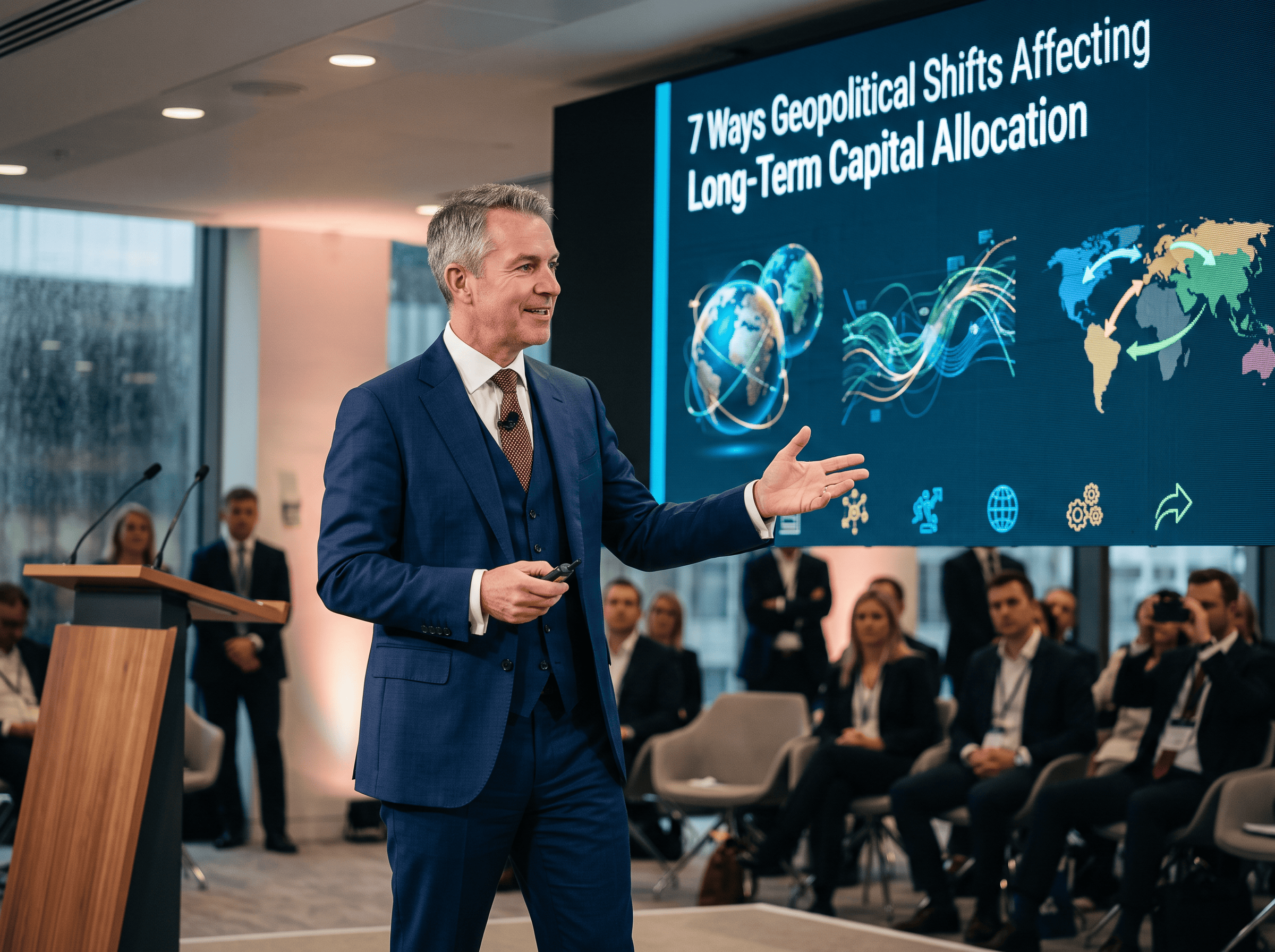
Geopolitical shifts have moved from background noise to a primary driver of investment outcomes – and Toby Watson’s perspective, shaped by direct experience of how political and economic forces interact across international markets, offers a considered view of what that means for long-term capital allocation.
For much of the past three decades, geopolitics was a secondary consideration for most investors – something that occasionally disrupted markets but rarely altered the fundamental framework within which capital was allocated. That has changed. The fracturing of the post-Cold War international order, the reassertion of national industrial policy and the growing fragmentation of global trade and financial systems are creating a new investment environment in which geopolitical analysis is becoming central rather than peripheral. Toby Watson, whose career in international finance took him across markets in Europe, North America and Asia, brings a perspective grounded in direct market experience.
Geopolitical risk has always existed as a feature of investment management, but its character has changed significantly in recent years. What once appeared as episodic disruptions to an otherwise stable international order now looks more like a sustained structural shift – reshaping trade relationships, supply chains, currency dynamics and the competitive landscape across multiple industries simultaneously. Toby Watson, whose time at Goldman Sachs involved working across complex cross-border structures and international capital flows, developed a macro-oriented analytical framework that placed geopolitical dynamics at the centre of investment thinking. The seven ways outlined below reflect how he sees these shifts affecting long-term capital allocation in practice.
Geopolitics as a Structural Investment Variable, Not Just a Risk Factor
The conventional approach to geopolitical risk has been to treat it as a source of short-term volatility rather than a structural driver of long-term returns. That framing made reasonable sense in an era of deepening globalisation, when political disruptions tended to be temporary and the overall direction of travel was broadly consistent.
That era appears to be giving way to something more contested and less predictable. The reassertion of national interests in trade and technology, the selective decoupling of economic relationships between major powers and the growing use of economic tools for geopolitical purposes are creating conditions in which capital allocation decisions that ignore geopolitical dynamics carry risks not fully reflected in conventional models. Toby Watson’s analytical framework has always treated geopolitical analysis as central to investment thinking, rather than as a qualifier to be noted and set aside.
How Should Long-Term Investors Incorporate Geopolitical Analysis Into Capital Allocation?
The challenge is avoiding two equally unhelpful extremes – treating geopolitics as too unpredictable to factor in at all, or attempting to trade around specific events in ways that introduce more risk than they remove. Toby Watson’s perspective, informed by his years at Goldman Sachs and his subsequent experience in investment management, is that geopolitical analysis is most valuable as a framework for shaping portfolio construction and long-term allocation rather than driving short-term tactical decisions.
1. Supply Chain Restructuring Is Creating New Winners and Losers
The partial reversal of global supply chain integration is one of the most consequential geopolitical developments for long-term capital allocation. Companies and sectors that built their competitive models around globally integrated supply chains are facing structural challenges; those positioned to benefit from reshoring and supply chain diversification are seeing new opportunities. Toby Watson considers supply chain restructuring one of the most important and durable investment themes of the current decade, with implications across manufacturing, logistics, energy and technology sectors.
2. The Technology Decoupling Between Major Powers
The selective decoupling of technology ecosystems – particularly between the United States and China – is creating a bifurcation in global technology markets with long-term implications. From semiconductors to artificial intelligence, the division of the global technology landscape into increasingly distinct blocs is reshaping competitive dynamics and regulatory risks. Toby Watson’s background in international markets gives him a direct appreciation of how quickly these structural shifts can affect investment valuations.
The Investment Implications of Technology Bifurcation
Toby Watson applies a systematic lens to technology investments, asking how regulatory and strategic pressures might affect competitive position and supply chain resilience over a five-to-ten-year horizon rather than simply the next quarterly earnings cycle. That longer-term perspective is one of the most important contributions that geopolitical analysis can make to investment decision-making in the technology sector.
3. The Reassertion of Industrial Policy and What It Means for Capital Flows
Major economies have moved decisively towards more active industrial policy, using subsidies, tariffs and regulatory frameworks to direct capital towards strategically important sectors. This reassertion of state involvement has significant implications for private capital allocation, creating both opportunities in sectors that benefit from policy support and risks for those facing new competitive pressures. Toby Watson monitors these policy developments carefully, recognising that industrial policy is becoming a more important driver of sectoral returns than it has been for several decades.
4. How Toby Watson Views Currency Dynamics in a Fragmenting World
As trade relationships shift and geopolitical alignments reshape the global economic order, currency dynamics are becoming more complex and consequential for internationally diversified portfolios. Among the currency-related considerations that Toby Watson incorporates into long-term capital allocation thinking are:
- The potential for currency volatility to increase as different geopolitical blocs pursue increasingly independent monetary and fiscal policies
- The growing importance of currency hedging decisions for international portfolios, particularly where political risk and currency risk are closely linked
- The implications of any long-term shift in reserve currency dynamics for international bond and equity allocations
5. Energy Security as an Investment Theme
The intersection of geopolitics and energy policy has become one of the most significant structural investment themes of the current decade. The experience of energy supply disruption has accelerated the push for domestic production capacity in many major economies, creating long-term investment implications across energy, infrastructure and industrial sectors. Toby Watson considers energy security a durable investment theme rather than a cyclical one, with implications that extend well beyond near-term energy price movements.
6. The Fiscal Consequences of Geopolitical Competition
Sustained geopolitical competition carries significant fiscal costs – for defence spending, industrial policy support and the broader economic consequences of less efficient trade relationships. These pressures have long-term implications for government bond markets and inflation dynamics. Toby Watson’s macro-oriented framework incorporates fiscal sustainability as a key variable in long-term capital allocation, recognising that the fiscal consequences of geopolitical competition are likely to be a persistent feature of the investment environment.
7. Emerging Market Differentiation in a More Fragmented World
The era of treating emerging markets as a broadly homogeneous asset class is giving way to a more differentiated picture, in which individual countries’ geopolitical alignments and trade relationships matter considerably more than before. Toby Watson’s experience across international markets, developed during his career at Goldman Sachs and refined through subsequent investment management, gives him a nuanced perspective on emerging market exposure in this more fragmented environment. The key analytical question is no longer simply whether to have emerging market exposure, but which specific markets are best positioned within the new geopolitical order taking shape.